


The question of how to plan a funeral may be an overwhelming one, especially if you have never done it before and don’t know what to expect.
There are many decisions that need to be made and many details to be attended to.
For this reason, many people choose to plan the funeral service with the assistance of a funeral home.
A reputable funeral home will provide you with helpful guidance and expert advice based on their years of experience.
In this guide on “How to Plan a Funeral,” we cover everything you need to know about the funeral planning process and provide invaluable advice from funeral directors who are leaders in their field.
TABLE OF CONTENT
How to Plan a Funeral Step By Step
How to Find a Great Funeral Home
The Role of the Funeral Home in the Funeral Planning Process
Your Role in the Funeral Planning Process
Practical Tips For How to Plan a Funeral Effectively
How to Plan a Funeral with Help From Love Lives On

How to Plan a Funeral Step By Step
The thought of funeral planning can feel daunting given the amount of factors to be considered.
It can also be an overwhelming task because of your own grief and emotional exhaustion.
We have broken down how to plan a funeral into a series of steps. Hopefully this will help guide your focus and provide a structure for the entire funeral planning process.
(1) Understand the Wishes of the Deceased
One of the most important starting points in funeral planning is identifying and honouring the wishes of the person who has died.
These wishes may be documented in a will, pre-arranged funeral plan, or advance directive, but they are often shared verbally with family members.
Preferences may include burial or cremation, religious or cultural traditions, music, readings, or even specific clothing.
When no clear wishes exist, families should aim for decisions that reflect the individual’s personality, values, and beliefs.
This step helps guide every other choice and can also reduce family conflict by providing a shared direction.
(2) Choose Type of Disposition
A major practical decision in funeral planning is how the body will be laid to rest.
Burial and cremation are the most common options, but green burials, mausoleums, and other alternatives may also be available depending on location.
Each choice has different costs, timelines, and emotional implications.
Families often weigh environmental considerations, religious teachings, and personal sentiment when deciding.
Understanding these options early helps avoid rushed decisions later and allows time to explore cemeteries, crematoriums, or natural burial sites if needed.
(4) Understand Costs and Set a Budget
Funerals can vary widely in price, so establishing a realistic budget early in the funeral planning process is both practical and protective.
Costs may include the funeral home’s services, transportation, caskets or urns, venue fees, flowers, printed materials, obituary notices, and catering.
Having a clear budget helps families prioritize what matters most and avoid unexpected expenses during an already stressful time.
Many funeral homes provide itemized price lists, which can be compared to ensure transparency.
Financial planning does not diminish the emotional significance of the service; rather, it allows families to make confident decisions without added financial strain.
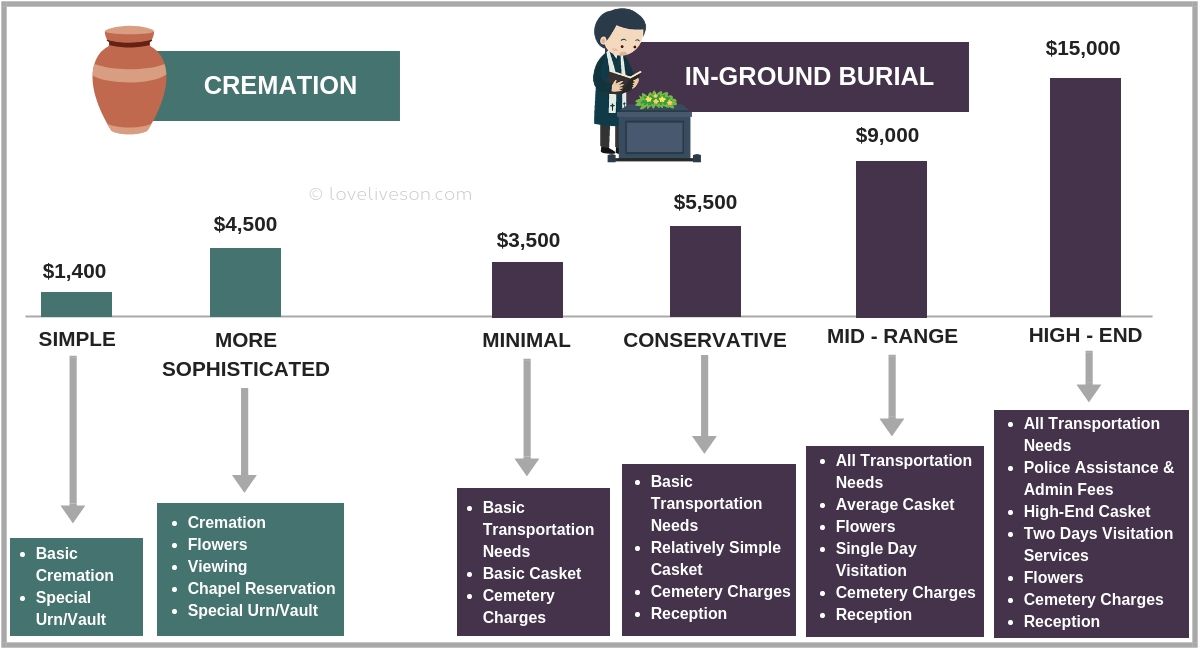
Here is an infographic that outlines the approximate costs associated with cremation and in-ground burial:
(5) Decide on the Type of Service
When considering how to plan a funeral, it’s important to remember that there is no single “right” way to hold a funeral.
Some families choose a traditional religious ceremony, while others prefer a memorial service, celebration of life, or private gathering.
The tone may be formal or informal, somber or uplifting, depending on the individual being honoured.
Deciding on the type of service helps shape choices about venue, music, speakers, and attire.
This is also the stage where families determine whether the service will be open to the public or limited to close friends and relatives.
(6) Select a Date, Time, and Location
Logistics play a significant role in funeral planning.
Coordinating schedules with the funeral home, clergy or celebrant, cemetery or crematorium, and out-of-town guests requires thoughtful timing.
Some families prefer a service within a few days, while others delay to allow travel arrangements or cultural observances.
Location choices may include funeral homes, places of worship, community halls, gravesides, or outdoor settings.
Accessibility, parking, and seating capacity are practical details that can greatly affect attendees’ comfort.
(7) Notify Family, Friends, and the Community
Communication is both a logistical and emotional task in the funeral planning process.
Families may choose to notify close relatives personally before issuing a public obituary or social media announcement.
Obituaries often include service details, biographical highlights, and donation preferences.
Sensitivity and clarity are key, as people rely on these notices to understand how to offer support or attend services.
Delegating notification duties to trusted friends or relatives can ease the burden on immediate family members.
(8) Personalize the Service
When it comes to thinking about how to plan a funeral, don’t forge to include personal touches.
They transform a funeral from a “cookie-cutter” event into a more meaningful tribute.
Music playlists, photo displays, memory tables, video slideshows, favourite foods, or symbolic rituals can all reflect the individual’s life and passions.
Personalization helps attendees connect emotionally and celebrate memories rather than focusing solely on loss.
Even small details — such as a favourite flower or colour theme — can create a sense of warmth and authenticity.
(9) Perform Legal and Administrative Tasks
Behind the scenes, several administrative steps must be completed during the funeral planning process.
These often include registering the death, obtaining death certificates, notifying government agencies, and beginning insurance or benefit claims.
Funeral homes frequently assist with these tasks, but families should still gather identification documents and legal paperwork early.
Though these duties can feel impersonal, completing them efficiently prevents complications later.
(10) Take Care of Further Tasks After the Funeral Service
Planning does not end when the service concludes.
Families may need to send thank-you notes, choose memorial markers, manage ashes, or organize charitable donations made in the person’s name.
There may also be estate matters and property decisions to address.
Recognizing these future steps in advance helps families feel less overwhelmed when the immediate ceremonies are over.
(11) Care for Yourself
Funeral planning often occurs during intense grief, fatigue, and emotional shock.
Allowing space for rest, sharing responsibilities, and accepting help from others are essential acts of self-care.
Decision fatigue is real, and taking breaks can lead to clearer choices. Remembering that perfection is not the goal — honouring a life is — can ease pressure.
A compassionate approach to both logistics and emotions ensures the planning process supports healing rather than adding further strain.

How to Find a Great Funeral Home
Our mission at Love Lives On is to make your life a little easier during a difficult time.
To find a reputable local funeral home, please visit Love Lives On’s Business Directory.
Our Business Directory is dedicated to helping you find the very best end-of-life professionals, including funeral homes, monuments makers, florists, celebrants, estate lawyers, grief counsellors, and so much more.
Businesses with Featured Listings in our directory – the comprehensive listings that appear at the top of search results with photos, reviews, and map directions – have all been carefully vetted by our team so that you don’t have to take on this laborious task.
Unlike other directories, joining Love Lives On is by invitation only. We work with an exclusive list of businesses.
You can trust that businesses with Featured Listings meet the highest standards for quality, professionalism and reliability.
If our directory doesn’t have Featured Listings yet yet for your area, (it takes time for us to do the required research), consider asking family and friends for their recommendations.
In the event you take this approach, ensure that you ask what year they were served by the funeral home they are recommending.
If it was some time ago, it’s probably a good idea to check that ownership of that funeral home hasn’t changed hands in the meantime.

The Role of the Funeral Home in the Funeral Planning Process
When it comes to how to plan a funeral, the funeral home and its staff play a critical role in both planning the funeral or memorial service and carrying it out.
Funeral directors are intimately familiar with what needs to be done in order to care for the body of your deceased loved one, and to honour his or her life.
They are also highly-experienced in providing practical advice and assistance to grieving families who have difficult and important decisions to make.
Funeral directors are there to help you create a unique and beautiful service that fits your needs and values and celebrates the life of your loved one.
They are also well-equipped to help you understand various burial options and to explain the different products and services available.
Funeral directors are instrumental throughout the entire funeral planning process. Their duties include:
- Removing the body after the death
- Preparing you and your family for the viewing of the body
- Obtaining all the necessary legal documents
- Planning the service
- Arranging final disposition of the body
- Providing the facilities for the visitation and funeral or memorial service
- Transporting the deceased and mourners from the location of the service to the final burial site
- Supporting families throughout the entire funeral planning process and after the funeral service has been carried out
The funeral home staff also have a great deal of experience and training in helping mourners through the grieving process in an environment that promotes healing.
When it comes to how to plan a funeral, a caring funeral home will carry the heavy load of tasks that need to be done for you so that you can focus on saying goodbye to your loved one.

Your Role in the Funeral Planning Process
Funeral planning is a significant and highly-involved task.
When it comes to how to plan a funeral, we suggest taking a methodical approach.
There are many decisions that will need to be made by you and your family during the funeral planning process, including:
Body Disposition Details
- What is to be done with the body in terms of disposition (e.g. burial, cremation)
- What is the budget for body disposition
- What type casket or urn
- Do you need a casket liner and a vault
- Which cemetery will be used, (if applicable)
- What type of cemetery space (e.g. burial plot, cremation plot, mausoleum, niche, green burial plot)
Service Details
- When and where will the service be held (e.g. church, funeral home, other venue)
- How will you let people know about the service (e.g. phone calls, social media, email, text message, obituary or funeral notice)
- What type of service (e.g. traditional funeral, memorial service, celebration of life, religious service, cultural service)
- What is the budget for the service
- Do you want a central “theme” for the service because your loved one had a particular passion in life (e.g. gardening, golf, travel)
- What type of flower arrangements do you want in terms of shape, size, and colour scheme
- Which florist will you use
- Who is to officiate the service (e.g. celebrant, clergy)
- Who will be pallbearers (either honorary or with a carrying role)
- What music do you want for the service (e.g. hymns, classical, contemporary)
- What should be in the printed program (e.g. photo of the deceased, short biography, order of service, name of participants in the service, reception details (optional), thank you message from the family to the attendees)
- What type of personal touches in terms of decor do you want
- Which poems and readings do you want for the service
- Who will deliver the poems and readings
- Who will deliver the eulogy or eulogies
- Will there be a photo tribute at the service and, if so, which photos should be included
- How is the procession to be organized and which vehicles will be used
Reception Details
- Are you having a funeral reception and who will be invited (e.g. close friends and family only or all attendees)
- What is the budget for the funeral reception
- Where will the funeral reception be held (e.g. funeral home, restaurant, community centre, private home)
- When will the funeral reception take place (e.g. immediately after the service, or at some later date)
- How will invitations to the funeral reception be extended (e.g. phone calls, email, text message, social media, in the post)
- What is the service style (e.g. finger foods, buffet, or formal seated dinner)
- What food will be served
- What beverages will be served
- Will the meal and drinks be professionally catered and, if so, what catering company will you use
- How will the venue be personalized to commemorate the deceased (e.g. memory display tables, photo tributes, guestbooks, keepsakes for attendees)
- What background music will be played at the reception
Post Funeral Service Details
- Who should be sent a thank you card for their help and support (e.g. people who participated in the ceremony, people who helped with the service behind the scenes, people who dropped off food, people who travelled a great distance to attend, the funeral home staff)
- Who in the family will take responsibility for writing the thank you cards
- What type of grave marker and what information should appear on it
- What type of government paperwork and other official paperwork needs to be completed
What to do When You Feel Overwhelmed
If you are feeling overwhelmed by all of these funeral planning tasks, you can – and should – ask the funeral directors to assist you with making decisions.
Their role is to gently help you navigate the decision making process.
Without their expert direction and guidance, you can feel like you are drowning in a “to do” list.
Funeral directors have planned many funerals and have practical insights on how best to honour a loved one’s life and legacy.
They also have practical insights on how best to ensure the day of the funeral runs smoothly – insights that have been gleaned from years of experience.
Given how central the role of the funeral director is when it comes to funeral planning, it’s vital that you select a funeral home that you fully trust.
A great funeral home will always have your best interests at heart, and the value and support that they provide during a difficult time is immeasurable.

Related Articles





Practical Tips For How to Plan a Funeral Effectively
When it comes to the question of how to plan a funeral so that it runs smoothly on the day, the biggest factor to consider is your relationship with the funeral home.
The following are some helpful tips for finding the right funeral home to work with, and for maintaining a a positive, cooperative relationship with the funeral directors.
(1) Choose a Funeral Home That Feels Right
Look for a funeral home where staff listen carefully, explain options clearly, and respect your values and budget.
Feeling comfortable asking questions is essential for the funeral planning process to run smoothly.
Working with a funeral director that you feel comfortable with, one who is knowledgeable, and whose input you trust is key to a successful relationship.
Trust your gut!
(2) Ask Questions — Even the Small Ones
No question is insignificant.
Funeral directors expect and welcome questions, especially from families planning a funeral for the first time.
(3) Be Honest About Your Budget
Sharing your funeral planning budget upfront helps the funeral director recommend options that meet your needs without unnecessary pressure or surprises.
Some individuals may feel that funeral homes are out to take advantage of people in vulnerable situations and charge them far more money than is necessary.
This misconception stems from the fact that people do not understand the different products and services that funeral homes provide.
When they receive a large bill they can be upset and confused.
If you feel that your funeral service quote is high, or you don’t understand why you need to spend money on something like a casket liner, ask your funeral provider to explain the associated costs.
Ask them to review the itemized price list for the entire funeral – you will see that many of the costs charged are paid out to external vendors such as florists and newspapers for obituaries.
Often, people just do not understand the purpose for some of the auxiliary products suggested by the funeral providers.
These are not decisions you are faced with every day.
By asking for clarification you will put your mind at ease and facilitate a trusting relationship.
(4) Take Notes and Ask for Written Information
When it comes to thinking about how to plan a funeral, be aware that grief can make it hard to remember fine details.
Ask your funeral director for written estimates and checklists to help you review information later with clarity.
We also suggest that you take notes during your meetings with the funeral home. You’ll be able to refer to your notes if you forget what was discussed or decided.
(5) Don’t Feel Rushed to Decide Everything at Once
Not all choices must be made immediately. Some choices can be made as the funeral planning process progresses.
Ask the funeral director which decisions are urgent and which can wait. This gives you time to process all of the information that you have to absorb.
(6) Know When to Take a Step Back
When it comes to how to plan a funeral, many people are surprised by our advice that it is important to know when to take a step back and let your funeral directors take the lead.
While you will naturally want to take the lead on certain topics – for example, how to personalize the funeral service so that it best reflects the life of your loved one – it is nevertheless important to be open to the suggestions provided by the professionals.
Remember, you hired them for their knowledge and expertise.
(7) Bring a Trusted Support Person
Having another family member or friend present can help with decision-making, note-taking, and emotional support.
(8) Know When to Pause and Take a Break
If discussions become overwhelming, it’s okay to step back.
Funeral planning works best when families feel supported and comfortable.

How to Plan a Funeral with Help From Love Lives On
We hope you found this guide on how to plan a funeral helpful.
Our goal was to make the funeral planning process less daunting, especially given that it may be an overwhelming and difficult time for you.
Here are some other articles on Love Lives On that closely relate to how to plan a funeral that you might useful:
- 100+ Best Celebration of Life Ideas
- Curated List of Beautiful Songs for a Funeral Service
- Guidebooks on How to Design a Funeral Service Around a Theme
- What to Wear to a Funeral for Women
- What to Wear to a Funeral for Men
You can also find more useful and shareable content by clicking on the Pin below to be taken to our Pinterest board.
On behalf of all of us at Love Lives On, please accept our deepest condolences for your loss.
We are here for you and we are committed to helping you find the right funeral home – one that is passionate about helping grieving families carry their burdens.