In this practical guide on how to choose a funeral home when a loved one has passed away, we cover everything you need to know before signing a contract.
Selecting a funeral home that is professional, knowledgeable and caring is understandably important to you and your family.
A reputable funeral home not only will help you organize an end-of-life ceremony – a service that truly honours your loved one’s life and legacy – they also provide much-needed support, both practical and emotional.
Our goal is to help you be fully confident that you have selected an excellent funeral home to care for your deceased loved one, as well as you and your family.
TABLE OF CONTENTS
How to Choose a Funeral Home Step 1: Determine Your Criteria
How to Choose a Funeral Home Step 2: Research
How to Choose a Funeral Home Step 3: Schedule a Consultation
How to Choose a Funeral Home Step 4: Gather Documents & Personal Items
How to Choose a Funeral Home Step 5: Visit & Ask Questions
How to Choose a Funeral Home Step 6: Do a “Gut Check”
How to Choose a Funeral Home Step 7: Review & Sign the Contract

How to Choose a Funeral Home Step 1: Determine Your Criteria
Pre-determining your selection criteria for a funeral home is essential because it allows you to make informed, calm decisions during a time of high emotional distress.Discussing your preferences with your family members before choosing a funeral home can also help prevent disagreements later on.
Establishing these criteria in advance helps avoid common pitfalls like overspending, selecting a location that is difficult to access, or choosing a funeral home that does not match your family’s cultural or religious needs.
Here are some important issues to consider before you begin your search for a funeral home – issues that you should discuss with your family in order to try to avoid misunderstandings and conflict, (if needed).
Funeral Home Location
What city or town – or suburb for larger cities – will the funeral take place in? (This will narrow your search parameters.)
Funeral Home Profile
Do I want to work with an independently-owned funeral home or a corporate-owned funeral home, or does it not matter to me?
Do I want to only work with a funeral home that has a particular religious or cultural affiliation?
Does it matter to me how long the funeral home has been in business?
Do we need a home with disability access because we are planning to host functions at the home?
Funeral Home Service Offerings
Do I only want to work with a full-service funeral home – a “one-stop shop” that offers both cremation and burial services, as well as a wide range of funeral ceremony options?
Do I want burial for my loved one? If yes, do I want to only work with a funeral home that operates its own cemetery?
Do I want cremation for my loved one? If yes, do I want to only work with a funeral home that operates its own crematorium?
Do I want a traditional funeral service, a memorial service, or a highly-personalized celebration of life for my loved one?
Do I want a green funeral for my loved one?

How to Choose a Funeral Home Step 2: Research
Our mission at Love Lives On is to make your life a little easier during a difficult time.
To find a reputable local funeral home, please visit Love Lives On’s Business Directory.
Our Business Directory is dedicated to helping you find the very best end-of-life professionals, including funeral homes, monuments makers, florists, celebrants, estate lawyers, grief counsellors, and so much more.
Businesses with Featured Listings in our directory – the comprehensive listings that appear at the top of search results with photos, reviews, and map directions – have all been carefully vetted by our team so that you don’t have to take on this laborious task.
Unlike other directories, joining Love Lives On is by invitation only. We work with an exclusive list of businesses.
You can trust that businesses with Featured Listings meet the highest standards for quality, professionalism and reliability.
If our directory doesn’t have Featured Listings yet yet for your area, (it takes time for us to do the required research), consider asking family and friends for their recommendations.
In the event you take this approach, ensure that you ask what year they were served by the funeral home they are recommending.
If it was some time ago, it’s probably a good idea to check that ownership of that funeral home hasn’t changed hands in the meantime.
Once you have a list of two or three prospective funeral homes, you might consider creating a table to keep track of the relevant information.
In the vertical column on the left hand side, write down the criteria that are important to you.
Be mindful that if you have too many criteria on your wish list, you may not find a funeral home that meets all of them.
In the top, horizontal row, write down the funeral homes in the area that you are considering, along with the phone number for each reference.
For example:
|
ABC Funeral Home Phone Number |
XYZ Funeral Home Phone Number |
MNO Funeral Home Phone Number |
|
|
Offers cremation |
|||
|
Owns a crematorium |
|||
|
Family-owned |
|||
|
In business for 10+ years |
|||
|
Experienced in life celebrations |

Related Articles





How to Choose a Funeral Home Step 3: Schedule a Consultation
Review the table of information that you have completed.
Decided which funeral home (or homes) may be a good fit for you and your family’s needs.
Call the funeral home (or homes) to schedule an initial consultation.
It is best to visit the home in person so that you can tour the facilities to ensure that they are clean and adequately sized.
You also want to speak with the funeral director who will be in charge of making arrangements so that you can ensure that working together will be a good fit for both of you.

How to Choose a Funeral Home Step 4: Gather Documents & Personal Items
Once you choose a funeral home, your funeral director will need certain information and documents in order to complete necessary legal paperwork.
The funeral home will likely also need personal items of the deceased, so be sure to look through his or her belongings.
Information
- Deceased’s date of death
- Deceased’s place of death
- Deceased’s social insurance number
- Deceased’s health care card number
- Driver’s license number
- Deceased’s complete mailing address (P.O. Box is not acceptable)
- Deceased’s martial status at the time of death
The following information may also be required:
- Date, place, and time of funeral service
- Name and telephone number of the officiating celebrant, priest, pastor, minister, or other spiritual leader
- Draft copy of the obituary or death notice. (If you wish the funeral home to draft one on your behalf, bring a list of the details to be used in the obituary or death notice)
- Full names of casket bearers or honorary bearers
- Full names of people with speaking roles at the service
Documents
- Deceased’s Birth Certificate.
- Deceased’s Marriage Certificate.
- Deceased’s Military Discharge papers (if applicable).
- Deceased’s Last Will and Testament and any Codicils (if available).
- Deceased’s Durable Power of Attorney for Health Care (if available).
- Revocable Living Trust (if applicable).
- Deceased’s funeral pre-arrangement documents (if available).
Personal Items
- A good quality photograph of the deceased for use in the service and printed materials
- Picture of the deceased for grooming and hairdressing purposes
- Clothing for the deceased (undergarments and shoes are optional)

How to Choose a Funeral Home Step 5: Visit & Ask Questions
It is important to visit the funeral home so that you can see what they offer in terms of their facilities, the level of quality and cleanliness of the rooms and furnishings, and your comfort level with the staff.
During the initial consultation, some of the questions you might ask are:
- What types of services do you offer?
- Is a casket necessary and what types are available?
- What is embalming and is it required?
- What are the burial and cremation options?
- Can I have a price list before making any decisions?
- How long have you been in business?
- What memberships and licenses do you and your staff members maintain? Can I see a copy of your license?
- Are you independently or corporately owned?
- Do you hire any services from other providers or do you provide them all yourself?
- What are some funeral or memorial service options?
- Is our family able to customize the ceremony to meet special preferences we may have?
- Why is this funeral home the right choice for me?
- Can you provide me with a written quote and a copy of your standard contract so that I can review it at home?
- Can you provide me with a copy of the cemetery or crematorium’s by-laws?
- What payment options do you offer?
- Can I tour your facilities?
It is important to not make an impulsive decision. Take the time to properly review the information, quote and contract provided by the funeral home.
Visit a couple of funeral homes until you find one that you feel comfortable with.

How to Choose a Funeral Home Step 6: Do a “Gut Check”
More often than not, ensuring a funeral home is the right one often comes down to whether or not the funeral director is someone you can trust and depend on.
So what makes a great funeral director? It’s a combination of strong interpersonal skills, professional knowledge, organization and creativity.
You also don’t want a funeral director that makes you feel uncomfortable because he or she uses high-pressure sales tactics.
Here are the qualities that a great funeral director will have:
1. Strong Interpersonal Skills
One of the most important qualities that a great funeral director will have is great communication skills.
You should feel that you are able to discuss your needs and fears openly with your funeral director, and that he or she is listening and taking note of what you say.
You should also feel that he or she is communicating with you honestly and has your best interests at heart.
It’s also important that he or she is reassuring that you can ask as many questions as you like, and that you can call any time if you have further thoughts or concerns.
Since losing a loved one is often a stressful time for a family, a great funeral director is able to manage any tension within the family with his or her calm manner.
2. Strong Professional Knowledge
A great funeral director is able to plan a funeral that fits with your family’s customs and traditions.
He or she brings a wealth of experience in helping you design a ceremony that best honours your loved one.
He or she is also able to help you with post-death paperwork, like obtaining a death certificate.
Finally, a great funeral director will have a lay knowledge of counselling.
He or she will also be able to direct you to professional therapists should further grief support be required.
3. Strong Organizational Skills
There are many moving parts in funeral planning.
A great funeral director is able to keep track of all the details and ensure that on the day, the funeral service runs smoothly.
One of the best reasons for engaging the services of a funeral director is that you can let go of the burden of ensuring that all the details are taken care of and focus instead on saying goodbye to your loved one.
4. High Level of Creativity
Last, but not least, a great funeral director will not plan “cookie-cutter” funerals.
Instead, he or she will be invested in making it a service that truly honours the life of your loved one in ways that are unique and meaningful.
A great funeral director will plan to perfection a funeral service that is memorable and touching for all those who attend.
This skill requires a great deal of forethought and creativity.
5. Relaxed Approach (Does Not Engage in High-Pressure Sales Tactics)
A great funeral director avoids high-pressure sales tactics because their primary responsibility is to provide empathetic, ethical, and transparent support to grieving families, rather than maximizing profit.
High-pressure techniques — such as guilt-based selling (“don’t you want the best for them?”), upselling unnecessary packages, or creating artificial urgency — are considered exploitative of vulnerable people.
Here is why a great funeral director does not use these tactics:
Focus on Ethics and Professionalism
Reputable funeral directors adhere to codes of ethics that prioritize care for the deceased and compassion for the living, rather than sales goals.
Building Trust and Reputation
A good reputation is built on trust, honesty, and community referrals, not on making a high-pressure sale, which often leaves families feeling manipulated.
Vulnerability of the Client
Great directors recognize that grieving families are in a highly emotional, sensitive state and are susceptible to being taken advantage of.
Exploiting this, according to industry professionals, is considered unethical.
Legal and Regulatory Compliance
The Federal Trade Commission’s (FTC) Funeral Rule requires transparency, such as providing itemized price lists, which directly contradicts “bundling” or high-pressure upselling.
Empowering Informed Decisions
An honest director provides options and allows families to choose only the services they need or want, rather than forcing them into expensive, unnecessary, or pre-packaged services.
Long-Term Value
Professional funeral directors know that serving a family with dignity and respect leads to positive, long-term relationships, whereas high-pressure tactics are short-sighted and damage the industry’s reputation.
In contrast, high-pressure, “pushy” tactics are generally associated with commission-driven staff rather than professional funeral directors, and these methods are often viewed within the industry as unprofessional or “disgusting”.

How to Choose a Funeral Home Step 7: Review & Sign the Contract
It is important to review any legally binding document before you sign on the dotted line, including a contract with the funeral home for services and products.
Review the contract line by line with the funeral director. The contract must include the following:
- The name of the person who is paying for the contract (the Purchaser)
- The name of the person for whom the services or supplies are to be provided (the Recipient)
- The name of the funeral home you are dealing with (the Provider)
- A description of the services and supplies you have chosen and a description of when, under what circumstances and in what manner they are to be provided
- The price of each supply or service and the total price, including taxes
- All payment, cancellation and refund policies, including the right to change your mind and cancel the contract
- For interment rights make sure the contract also includes the location and description of the grave, crypt or niche
- For scattering rights, make sure the contract also includes the location and description of where the scattering may occur
- A copy of the cemetery’s approved by-laws
- A certificate of interment rights or scattering rights once these rights are paid in full. The certificate must include the name of the person who can legally authorize an interment or scattering
- The dates when payments are due, and the method by which payments can be made
For the contract to be valid (or “enforceable”), you and the funeral home must both sign the contract.
Again, do not sign anything until you review the terms and conditions of the contract carefully.
Make sure you get a copy of the contract after it is signed. Also request a receipt for money that you pay the funeral home.
If you buy supplies and services from a cemetery or crematorium, the funeral home will also give you a copy of its by-laws.
The by-laws set out any special rules that you must follow, including any restrictions on the purchase of supplies and services.

Infographic Summary
We have created this useful infographic that summarizes the main points made in this guide on how to choose a funeral home.
You can easily save it to your Pinterest page or other social media accounts for later reference.
(Click infographic to enlarge)
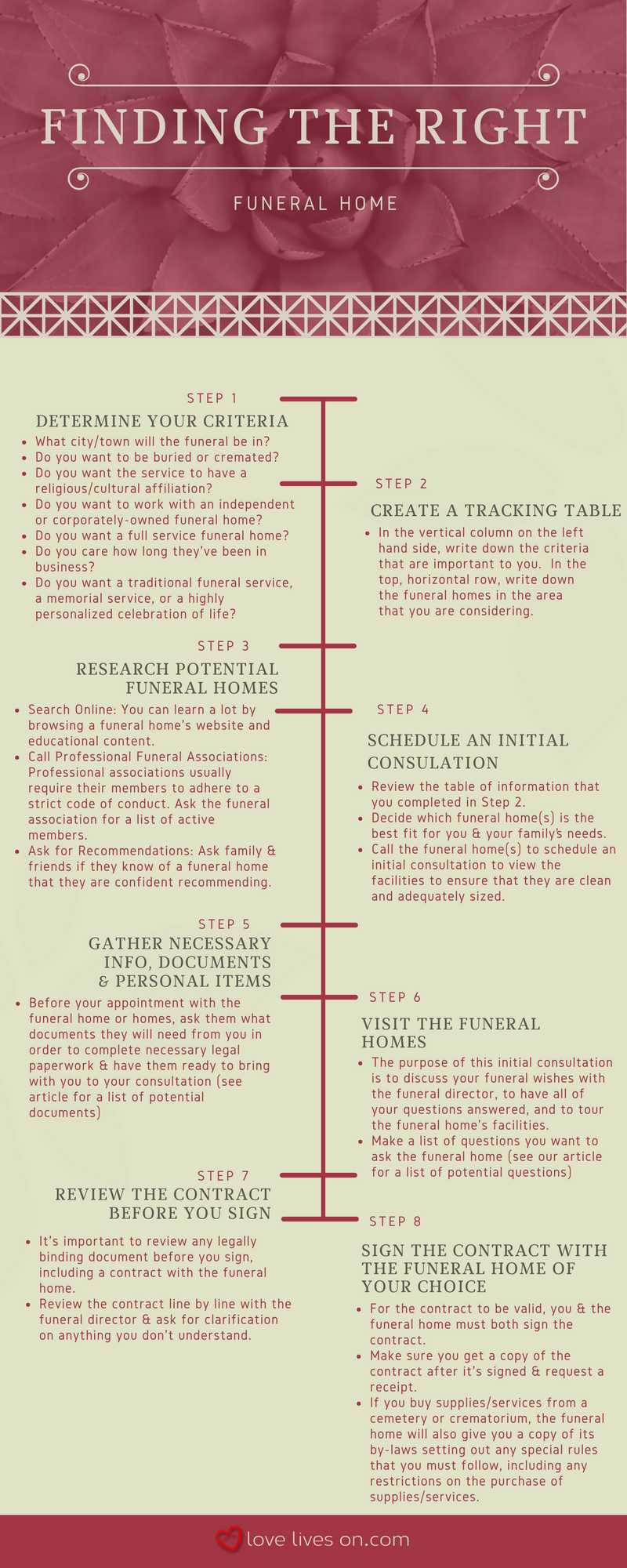
Like our infographic? Use it on your site by copying this code:

How Love Lives On Can Help
We hope you found this guide on how to choose a funeral home helpful.
Our goal was to make this task less daunting, especially given that it may be an overwhelming and difficult time for you.
Here are some other articles on Love Lives On you might useful:
- 100+ Best Celebration of Life Ideas
- Curated List of Beautiful Songs for a Funeral Service
- Guidebooks on How to Design a Funeral Service Around a Theme
- What to Wear to a Funeral for Women
- What to Wear to a Funeral for Men
Finally, on behalf of all of us at Love Lives On, please accept our deepest condolences for your loss.
We are here for you and we are committed to helping you find the right funeral home – one that is passionate about helping grieving families carry their burdens.