Looking for a grief definition that perfectly sums up what we experience when someone we love dies or after some other type of profound loss?
Overwhelming emotions are often difficult to talk about. Society labels these emotions as “grief”. But how can a simple word sum up such complex feelings?
In this article, we explore what the word “grief” means for us. Where did the word come from? Why do we use this word?
We also give you four profound grief definitions that actually get what you are going through.
Our grief definitions are backed by science, as they are derived from the work of world-renowned experts Elisabeth Kübler-Ross and David Kessler.
Finally, each grief definition that we present helps answer the ultimate question: “What does grief mean for my life?”
TABLE OF CONTENTS
- Grief Definition Through History
- Expert Advice on Death and Grieving
- Grief Definition 1: “Grief is a Highly Individual, Nonlinear Process”
- Grief Definition 2: “Grief is a Healing Process”
- Grief Definition 3: “Grief can be an Isolating Process”
- Grief Definition 4: “Grief can be a Transformative Process”
- Infographic Summary
- Additional Resources
- Get Individualized Support Today
Grief Definition Through History
The modern definition of grief is keen mental suffering or distress over a loss or affliction — a sharp sorrow — a painful regret.
At the very heart of the grief definition is intense sorrow. Grief is a deep emotional response to a great loss.
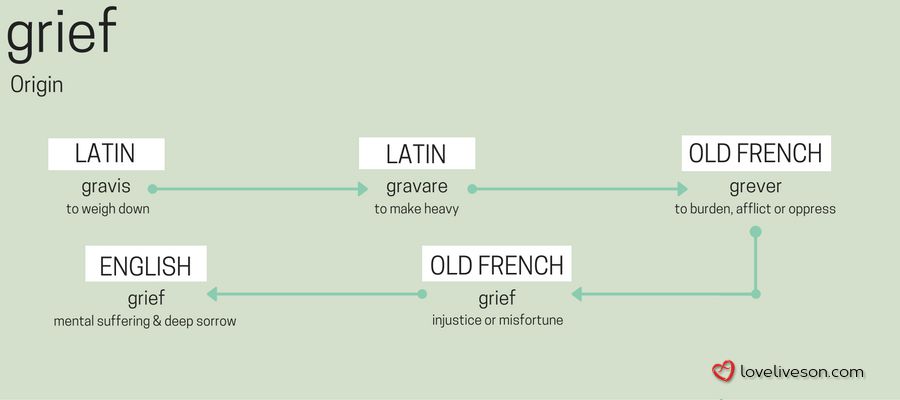
You may not be aware that we have been using the word grief in the English language for over 800 years, (though the Latin roots of the word go back even further).
The word grief was first used in the English language around the early 1200s to denote pain, hardship and suffering.
It came from the old French word “grief “ — using the same spelling — which referred to an injustice or a misfortune.
When a loved one dies, doesn’t it feel unfair and just plain wrong?
The Old French word “grief” came from another old French word “grever” — meaning to burden, afflict or oppress.
Doesn’t the loss of someone you love deeply feel like an emotional burden that is too hard to bear?
In turn, “grever” came from the Latin word “gravare” — which meant to make heavy — and which came from another Latin word “gravis” — which meant to make weighty.
Both Latin words denote a heaviness that weighs one down toward the earth, the very opposite of lightheartedness. Grief definitely feels like a heavy weight on our hearts.
Through the ages, people have grappled with the concept of what it means to grieve:
Expert Advice on Death and Grieving
Elisabeth Kübler-Ross’ ground-breaking work on dying, death and grieving changed the way that we talk about the end-of-life issues and about grieving.
She was a Swiss-American psychiatrist whose work with terminally ill patients led her to become a pioneer in near-death studies.
You might have heard of the five stages of grief — denial, anger, bargaining, depression, acceptance — a concept that was developed by Kübler-Ross and that has been adopted by many health-care professionals world-wide.
On her death-bed, Elisabeth Kübler-Ross partnered with David Kessler to write her final book titled “On Grief and Grieving: Finding the Meaning of Grief Through the Five Stages of Loss.”
(If you or someone you know is grieving the loss of a loved one, we cannot recommend this book highly enough.)
This ground-breaking book highlights that while we, as a society, tend to think of grief as an umbrella term covering a collection of negative emotions — for example, sadness, anger, despair — grief is, in fact, a natural, multifaceted process.
Here are four grief definitions that have been derived from the work of Kübler-Ross and Kessler that highlights that grief is ultimately a process:
- Grief is a highly individual, nonlinear process
- Grief is a healing process
- Grief can be an isolating process
- Grief can be a transformative process
We will explore each grief definition in detail below.

Grief Definition 1: “Grief is a Highly Individual, Nonlinear Process”
In their book, “On Grief and Grieving”, Kübler-Ross and Kessler explains that the concept of the five stages of grief is very misunderstood.
They acknowledges that Kübler-Ross has been accused of making humans seem like machines who mechanically move through the same emotions at the same pace after a loved one has died.
She has been accused of espousing, “first we are in denial; then naturally transition into anger; which is followed by bargaining; and then a period of depression; all of which then neatly resolves itself with the person accepting the loss. Grief over. Now on with life.”
On pg. 7 of “On Grief and Grieving”, Kübler-Ross and Kessler directly addresses the criticism:
“The stages have evolved since their introduction, and they have been very misunderstood over the past three decades.
“They were never meant to help tuck messy emotions into neat packages.
“They are responses to loss that many people have, but there is not a typical response to loss as there is no typical loss.
“Our grief is as individual as our lives.
“The five stages — denial, anger, bargaining, depression, and acceptance — are part of a framework that makes up our learning to live without the one we lost.
“They are tools to help us frame and identify what we may be feeling. But they are not stops on some linear timeline in grief.
“Not everyone goes through all of them or goes in a prescribed order.”
Further on at pg. 203 they write:
“Grief is not just a series of events, stages or timelines.
“Our society places enormous pressure on us to get over loss, to get through the grief.
But how long do you grieve for a husband of fifty years, a teenager killed in a car accident, a four-year-old child? A year? Five years? Forever?
“The loss happens in time, in fact in a moment, but its aftermath lasts a lifetime.
“Grief is real because loss is real. Each grief has its own imprint, as distinctive and as unique as the person we lost.”

Related Articles





Grief Definition 2: “Grief is a Healing Process”
One of the biggest lessons from “On Grief and Grieving” is that it is important to allow yourself to grieve freely and fully because doing so allows healing to take place.
Many people in our society don’t allow themselves to truly grieve because they think that crying uncontrollably is undignified or a sign of moral weakness.
Or they may resist fully exploring their grief because they fear that if they “let the genie out of the bottle” they will plunge into a pit of despair so deep that they will never climb out of it.
Kübler-Ross and Kessler are convinced that fully grieving is necessary if healing is to take place. On pgs. 203 and 204 of “On Grief and Grieving” they write:
“The pain of loss is so intense, so heartbreaking, because in loving we deeply connect with another human being, and grief is the reflection of the connection that has been lost.
“We think we want to avoid the grief, but really it is the pain of the loss we want to avoid.
“Grief is the healing process that ultimately brings us comfort in our pain. That pain and our love are forever connected.
“To avoid the pain of loss would be to avoid the love and the life we shared.
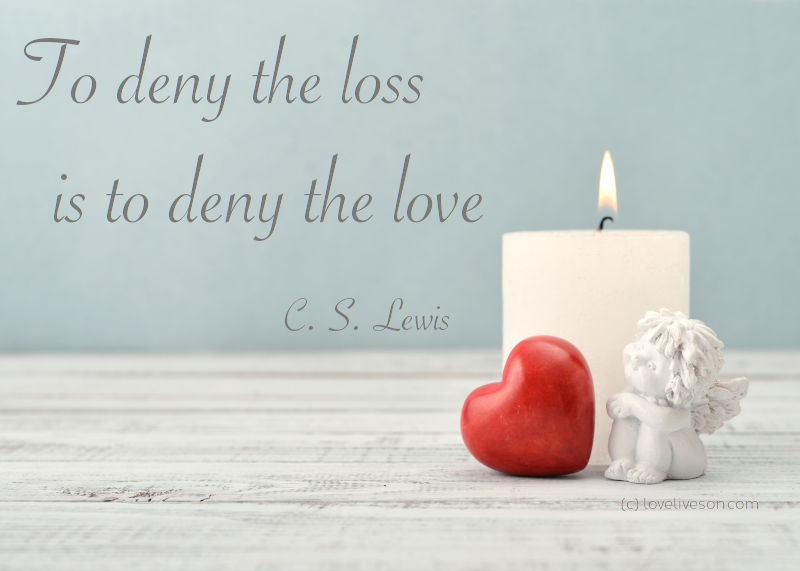
“C.S. Lewis said, ‘The pain now is part of the happiness then. That’s the deal.’ To deny that loss is to deny the love.”
When Kübler-Ross finally died, Kessler was inspired to add an “Afterward” to the book they wrote together.
On pg. 227 of “On Grief and Grieving”, Kessler wrote the follow passage after reflecting on the profound grieving process he personally went through after his dear friend, Kübler-Ross, passed away:
“Grief is the intense emotional response to the pain of a loss. It is the reflection of a connection that has been broken.
“Most important, grief is an emotional, spiritual, and psychological journey to healing. There is wonder in the power of grief. We don’t appreciate its healing powers, yet they are extraordinary and wondrous.
“It is just as amazing as the physical healing that occurs after a car accident or major surgery.
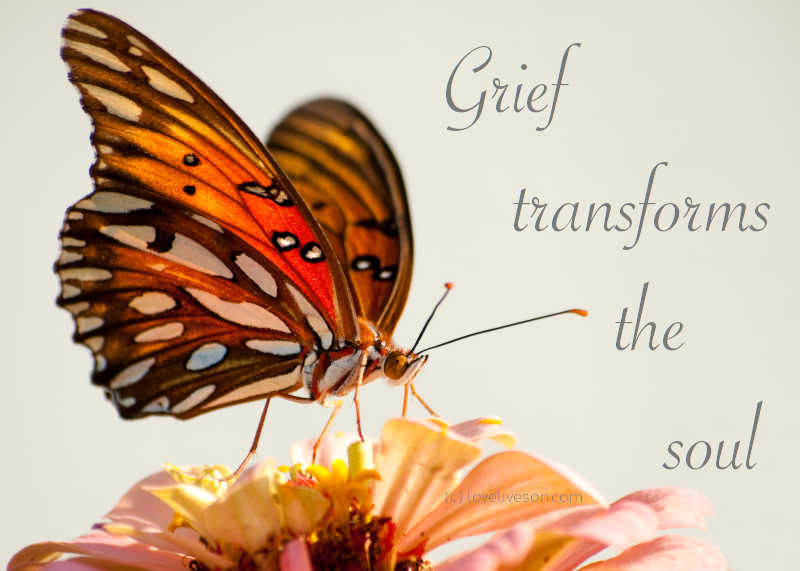
“Grief transforms the broken, wounded soul, a soul that no longer wants to get up in the morning, a soul that can find no reason for living, a soul that has suffered an unbelievable loss.
“Grief alone has the power to heal.”

Grief Definition 3: “Grief can be an Isolating Process”
While the grieving process is necessary for true healing, Kübler-Ross and Kessler acknowledge that it can also isolate us from those around us.
On pg. 204 of On Grief and Grieving they state:
“Healing grief is often an overwhelming and lonely experience.
We do not have any real framework to help us recover from the loss of a loved one. We do not think we have the tools to overcome the feelings that devastate us.
Our friends do not know what to say or how to help. As a result, during the days following a loss we wonder if we can survive.
As time passes, that fear gives way to anger, sadness, isolation, feelings that assault us one after another. We need help.”
Kübler-Ross and Kessler go on to speak about the power of community to break the feelings of isolation that surround the grieving.
Simply being together, sharing stories about the person that we loved, participating in funeral rituals, helps us feel connected to others while we grieve.

Grief Definition 4: “Grief can be a Transformative Process”
We can allow grief to destroy us, or we can use our grief to transform ourselves into better human beings.
In the face of grief, we can choose to become more kind, more thoughtful, and more grateful for the little things in life.
On pg. 207 of On Grief and Grieving, Kübler-Ross and Kessler encourage us to choose to grow in our grief:
“You can choose to make the process more meaningful.
As two people who have spent our lives dealing with loss and grief, we both visited concentration camps, where there are carvings of butterflies.
They are an enduring symbol of transformation, that even in the face of great loss we will continue, someway, somehow.
We spent time with Mother Teresa and witnessed the embodiment of human kindness.
In our worst we have the power to find some thread of hope. In grief, just like in death, there is a transformation for the living.
If you do not take the time to grieve, you cannot find a future in which loss is remembered and honoured without pain.”
Infographic Summary
Grief is not just a bundle of excruciatingly painful emotions. (Though it certainly feels that way a lot of the time.)
Grief is a process unique to each person — as unique as our personality and our relationship with the person that passed away. At times, it can feel like a lonely process.
However, grief is also a healing and transformative process, provided that you take the time to fully explore it, to fully feel your emotions.
Here is a helpful infographic that summarizes all of the facets of grief. Share it on social media, or save it on your Pinterest board.
(Click infographic for full resolution)
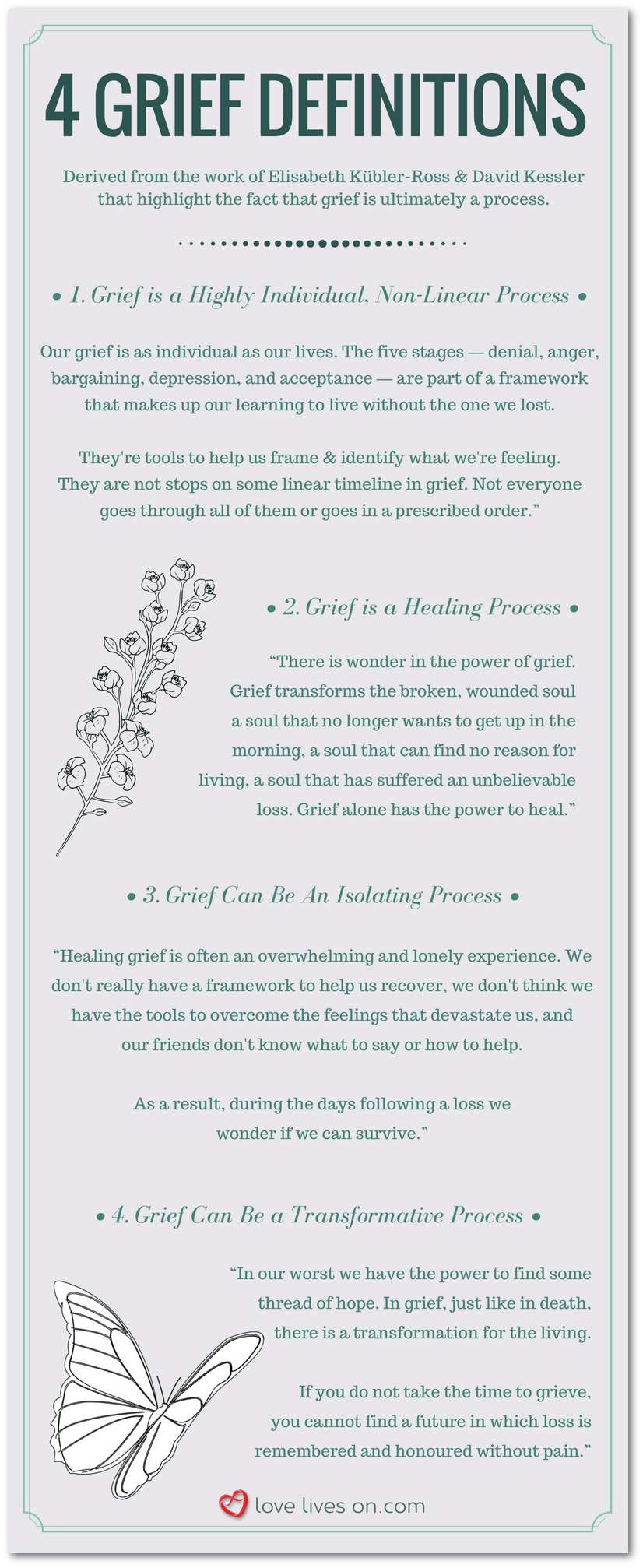
Like our infographic? Use it on your site by copying this embed code:
Additional Resources
Did you know that Love Lives On has a comprehensive library of articles on funeral planning, grieving, and celebrating your loved one’s life in unique ways?
Here are some other popular posts on our website:
- Practical advice on what to wear to a funeral
- Learn about the 5 stages of grief and how to cope
- Best examples to inspire you when writing a eulogy
- 100+ celebration of life ideas
Get Individualized Support Today
A grief definition give us a roadmap to what our grief journey may look like.
It can be a difficult an lonely road to travel, but there is hope that the journey may bring about a profound, positive transformation.
If you are struggling with grief, please visit Love Lives On’s Business Directory to find a skilled therapist in your local area who can provide you with one-on-one compassionate guidance and support.
Our Business Directory is dedicated to helping you find the very best end-of-life professionals, including grief counsellors, funeral homes, monuments makers, florists, celebrants, estate lawyers, and so much more.
Businesses with Featured Listings in our directory – the comprehensive listings that appear at the top of search results with photos, reviews, and map directions – have all been carefully vetted by our team so that you don’t have to take on this laborious task.
Unlike other directories, joining Love Lives On is by invitation only. We work with an exclusive list of businesses. You can trust that businesses with Featured Listings meet the highest standards for quality, professionalism and reliability.
We know that losing a loved one is a difficult experience.
Our mission at Love Lives On is to make your life a little easier by providing you with the best information online, as well as connecting you with caring and skilled professionals in your local area who are ready to help you today.
If we can assist you in any further way, please don’t hesitate to reach out to us via our contact form or social media channels. We love hearing from you and from other members of this devoted online community.
Finally, on behalf of all of us at Love Lives On, please accept our deepest condolences for your loss. If you are looking for more Love Lives On content, please click on the Pinterest Board below.