Many funeral homes – particularly those in competitive markets – rely on digital marketing to maintain or grow their call volume.
It makes sense to do so because we live in the digital age where 95% of consumers use the Internet to find services and products.
However, the digital marketing landscape is changing at lightening speed, so funeral home owners cannot afford to take a “business as usual” approach.
When it comes to Google Ads and Facebook Ads costs are skyrocketing while performance is plummeting. Google’s own AI predicts that this situation will only get worse because – at a fundamental level – consumers no longer trust digital ads.
The performance of Google Ads sank to an all-time low in 2025. This led Amazon – a multi-trillion dollar corporation – to stop paying for Google Ads.
If a behemoth like Amazon can’t afford to keep investing in ineffective Google Ads, can funeral homes?
It is clear that the heyday of digital ads is over.
Funeral homes that wish to maintain their current revenue level, especially in a tightening economy, are going to have to find a new source of online leads – one that is both reliable and affordable.
This Market Analysis delves into exactly how consumer preferences and rapidly changing technology is adversely affecting funeral home revenue.
It also provides five effective steps that funeral homes can implement immediately in order to safeguard their financial future.
Cost Per Click is Rising Dramatically
If your Google Ads budget is buying fewer leads than it did last year, you are not alone.
The average cost per click (CPC) across all industries rose 12% year-over-year to $2.96 in early 2026 — the steepest single-year jump since 2021.
For local service businesses like funeral homes, the spike is even harsher: clicks that cost $8 to $15 two years ago now regularly hit $15 to $60.
Looking at the long-term trend, LocaliQ benchmark data shows that the average search CPC has more than doubled over the last decade, climbing from $2.32 in 2016 to roughly $5.42 today.
While your exact numbers will vary by geography, one thing is certain: if your cost per lead is creeping up, you are not imagining it.
Usage of Ad Blocking Software is Increasing, Quarter After Quarter
Ad blocking software allows online users to block or alter online advertising in a web browser, an application or a network. It’s free to use, and allows people to customize and control their web experience.
The usage of ad blocking software continues to grow world-wide, largely in part because of “advertising fatigue”. To put it bluntly, consumers hate advertising, now more than ever.
A leading study by GWI, a global consumer research company, found that half of all consumers (50%) use ad-blocking software.
They predict that this percentage will continue to increase, quarter after quarter.
GWI also found that this trend is occurring across all age groups – boomers are just as likely to block ads and delete cookies as young adults.
Their findings align with those in the latest report from Eye/o, a leading developer of ad blocking software.
According to Eye/o’s study, in the 15 months between Q4 2021 and Q2 2023 user adoption of ad blocking software grew 11%:
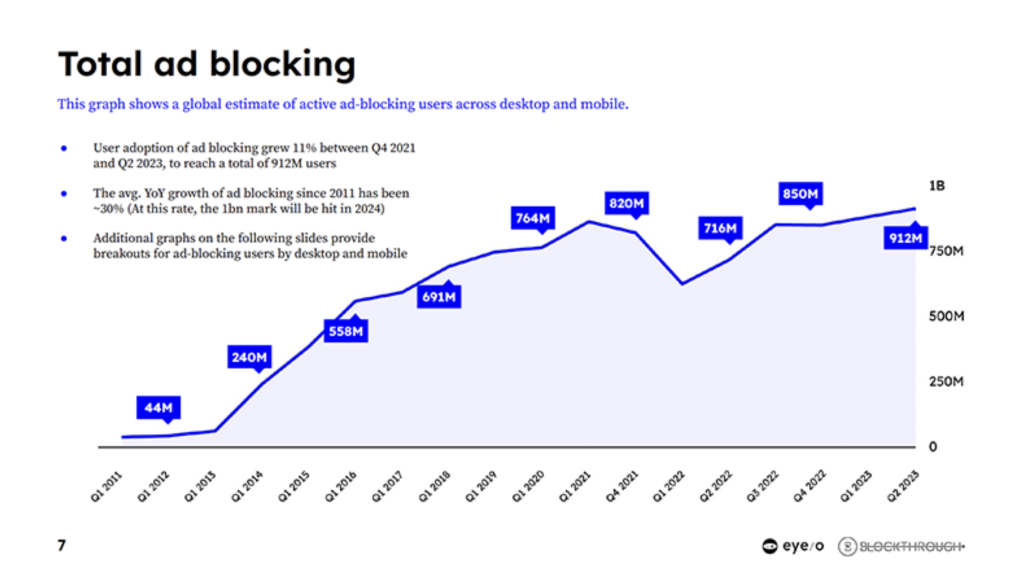
Both GWI and Eye/o used large data sets in their studies. They also both determined that the usage of ad blocking software is expected to continue increasing in 2024 and beyond.
This is worrying trend for funeral homes that rely on digital ads to either maintain or grow their call volume.
Consumers Ignore Google Ads in Favour of ‘Organic’ Content
In addition to increased usage of ad blocking software, consumers demonstrate their growing dislike for advertising with other types of online behaviour.
Today, consumers click on a Google Ad less than 5% of the time across all industries. (Many funeral homes report a click-through rate of 2.5% to 3.5%)
Instead, consumers will actively choose to scroll down the page to the unpaid (i.e. “organic”) search results for their query.
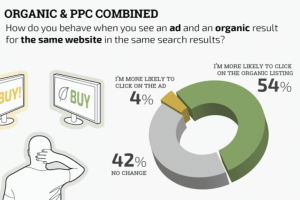
In fact, when consumers see a Google Ad and an organic search result for the same website in the same search results, 54% are more likely to click on the organic listing, even though it means that they have to scroll past the Google Ad to do so: see Richman SEO Training Infographic.
Even Google admits in their Official Blog that as high as 50% of clicks on Google Ads are accidental.
However, Google tells advertisers that this is due to design flaws in the way the ads are displayed, (with Google promising design improvements).
But consumer behaviour data clearly shows that consumers overwhelmingly prefer organic search results.
Improving how the ad is displayed may reduce accidental clicks, but it’s not going to increase the number of intentional clicks – consumers will still want to scroll past the Google Ads to get to organic search results.
Funeral homes are in a tough position. They need to connect with consumers online in order to maintain or grow their business, but consumers are turning their back on ads in favour of content.
Moreover, funeral homes cannot provide an appreciable amount of content on their website because they are not in the publishing business. It’s a prohibitively expensive endeavour to produce, publish and promote original content.
Funeral homes are also being done a disservice by digital marketing companies that aren’t being forthcoming about the growing consumer backlash against digital ads.
Since digital marketing companies sell their services doing Google Ads and Facebook Ads, they have a vested interest in not being transparent with the fact that digital ads are struggling to maintain their relevance with consumers.
The New York Times Predicted “Dangerous Days” Ahead For Advertisers
In late 2019, The New York Times reported that online advertising platforms like Google and Facebook had a “big problem” because “people hate advertising” with a passion – so much so that they’re even prepared to pay to NOT see ads.
The article explored how the greed of Google and Facebook are to blame. These media giants bombarded the Internet with advertising in order to maximize profits. It was not an “opt-in” experience for consumers who were forced to endure constant and unrelenting advertising.
The New York Times predicted “dangerous days” ahead for businesses that rely on digital ads, businesses like funeral homes. They predicted that advertising costs would increase, with advertisers chasing fewer and fewer clients.
“The problem is universal, and if the behaviour of younger audiences is a harbinger, things are not going to get better.”
Facebook in a “Death Spiral” as Users and Advertisers Flee
In late 2022, CNBC reported that Facebook (rebranded as “Meta”) was one of the worst performers of the year.
CNBC described Facebook as being in a “death spiral”, with industry experts doubting that Facebook had a viable long-term business.
Facebook’s core business has been, to date, advertising.
However, since 2022, users have been abandoning Facebook in droves in favour of platforms like TikTok.
Experts point out that Facebook is not connecting with young people, and add that social media platforms are easily abandoned. We should remember that “My Space” was, once upon a time, a dominant player.
In addition to users abandoning the platform, advertisers on Facebook face further problems when Apple made changes to its iOS.
The 2021 iOS privacy update, called App Tracking Transparency, undermined Facebook’s ability to target users with ads, costing the company an estimated $10 billion in revenue in 2022 alone.
This latest privacy update is simply a response to consumer demand for ad-blocking software.
If these problems weren’t enough for Facebook, the company has also faced an ongoing PR nightmare and damage to its reputation that will be difficult, if not impossible, to repair.
It has been called to account by senate committees for its lack of care and due diligence when it comes to children’s safety. Some U.S. senators compared the company to “Big Tobacco”.
Given the declining return on ad spend, advertisers began abandoning the platform too. The ones that stayed reduced their ad spend significantly.
Experts doubt that Facebook will be able to revive its core business, which is advertising, given the high rate of people leaving Facebook and consumer dislike of advertising.
They also point out that Facebook is betting heavily on developing AI and virtual reality products to ensure its long-term survival. However, AI doesn’t solve Facebook’s user abandonment problem and consumers might not be ready for virtual reality.
“When you look at [Facebook’s] user numbers,” says Chris Curtis, an online marketing expert and consultant, the company is “not in a good position.”
Facebook’s strategic re-orientation towards AI and virtual reality “may amount to little more than a Band-Aid”.
By April of 2024, CNBC reported that Facebook (Meta) had “weak revenue”.
Interestingly, Facebook no longer reports daily active users and monthly active users. It now gives a figure for what it calls “family daily active people.”
This change in how data is presented is perhaps an attempt by Facebook to obfuscate further declines in traffic.
While Facebook’s advertising revenue increased by 27% in the first quarter of 2024, this rise was due to massive spending by Chinese discount retailers like Temu and Shein “which have been pumping money into Facebook and Instagram in an effort to reach a wider swath of users”.
Some analysts have warned that slower spending from China-based advertisers due to economic pressures in China could be a source of concern for Facebook as time progresses.
It is also telling that Facebook had massive layoffs in 2023, cutting 21,000 jobs. Mark Zuckerberg said in February of 2024 that hiring will continue to be “relatively minimal compared to what we would have done historically”.
Given that users are using ad-blocking software, as well as abandoning Facebook in record numbers, does it make sense for businesses to continue to rely on Facebook to generate viable leads?
Given that “My Space” once ruled supreme, it may be a colossal business mistake to hitch your revenue wagon to Facebook’s fading star.
Even Google’s Own AI Admits Declining Performance in Google Ads
When querying Google whether it’s ad revenues are in decline, its own AI generated answer is as follows:
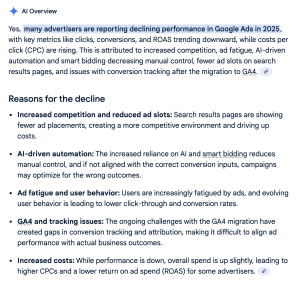
You can see from the screenshot above that Google Ads is in a full-blown existential crisis. It’s why, in 2025, Amazon ceased to buy advertising space from Google.
The bottom line for funeral homes is that Google Ads will yield an ever-decreasing number of new clients as time goes on, but at an ever-increasing cost.
Google Moves Away From Digital Ads Because of Declining Revenue
Now, here we are in 2025, and as predicted, Bloomberg is reporting that Google admitted that its advertising sales fell far below expectations in the fourth quarter.
Google advertising sales have, in fact, been falling since 2020, notes Bloomberg. Google’s “longtime addiction to the ad business” made the company “vulnerable to an array of economic speed-bumps”.
The continual decline in advertising sales is forcing Google to “rely less on the ad business that made it the Goliath it is now” and to diversify its revenue models, primarily with subscription-based services like cloud-storage.
Bloomberg states that “Google’s slow detox from ads is healthy,” but warns it could be a “rough transition”.
Here’s a graph created by Eric Benjamin Seufert using numbers provided by the company in SEC filings:
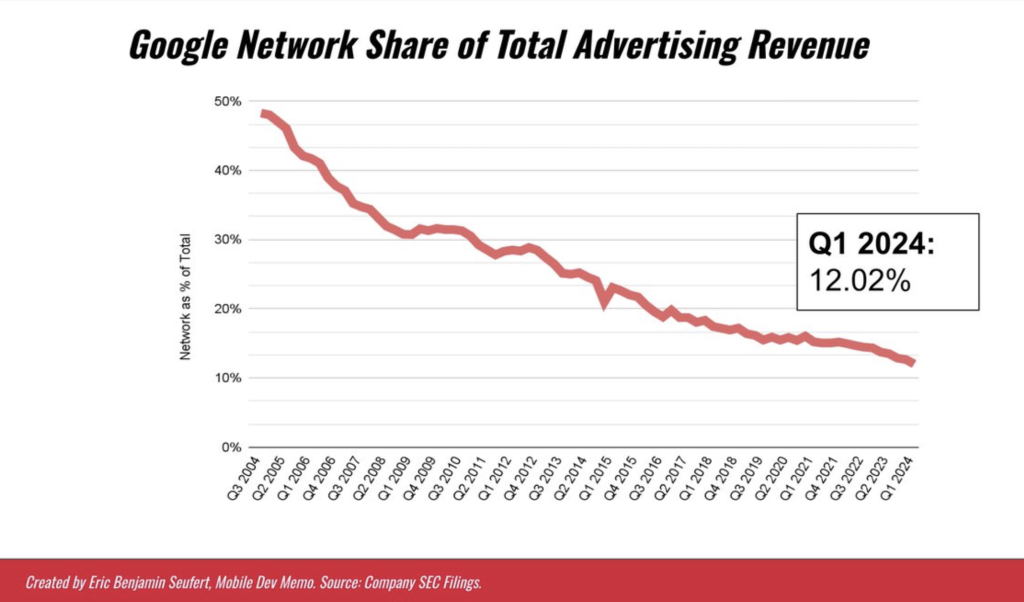
If Google itself cannot rely on revenue from its own ad platform, does it make sense for funeral homes to continue to heavily rely on Google Ads?
Like Google itself, funeral homes must diversify their online marketing strategy in order to protect themselves from “an array of economic speed-bumps”.
The bottom line is that all companies that rely on digital advertising must find new sources of online leads in order to maintain current revenue levels.
Even Google admitted in an August 2024 lawsuit that: “Google still faces intense competition, not just from general search engine firms, such as Microsoft’s Bing, but more specialised websites that people use to find [services].”
The Cost of Not Taking Action Now
Local businesses, including funeral homes, must take action now if they are hedge against disruptive changes in the digital marketing landscape.
The cost of not doing so is either stagnant business growth or, even worse, declining revenue.
Here are the five steps to take immediately:
(1) Figure Out What Your Ad Spend is Actually Getting You
How much are you spending on Facebook (Meta) and Google Ads per month? How many new clients is this actually getting you per month?
(2) Figure Out Where Your Ad Spend is Going, Not Just What it Costs
Where is the placement of your ad on the page of search results? This may have shifted, even in accounts nobody has touched.
(3) Fix Your Business Information Everywhere It Appears Online
For search engines to favour your business, you must use EXACTLY the same business name, address, and phone number across Google, Yelp, Apple Maps, the BBB, your chamber listing, and any industry directories.
This is not glamorous, but it underpins everything else.
Do not be tempted to use a different phone number for different ads in order to attempt to track which ad is generating you the most leads.
This hurts your business.
Not to mention, these one-off phone numbers that are used for ad tracking purposes are essentially rented your business – you do not own this phone number.
If an old client attempts to call you on that phone number in the future, and you no longer pay for the ad tracking service or no longer work with the digital marketing company that convinced you to rent the tracking phone number…
Your old client may now be in fact calling another business, or even a competitor!
(4) Hire a Professional Writer to Produce Articles for Your Business’ Website
Consumers today prefer valuable information.
They will prefer your website over competitors if your website offers a few helpful articles that are both well-researched and expertly written.
(5) Look for Other Websites in the End-of-Life Space That are Positioned to Send You Leads
Remember, Google itself has admitted that specialised websites are well-positioned to provide local businesses with valuable leads because consumers greatly prefer using specialised websites than clicking on a digital ad.
Consumers appreciate that specialised websites provide a large library of useful, unbiased information, and that they are able to surf through a well-designed website to find everything they need.
Funeral homes that list with a specialised website are leveraging that website’s success in building an information platform that attracts families needing funeral services in order to grow their own call volume.
Your first step here is to research websites that are dedicated to funeral planning and come up with a short list of potential candidates.
The next step is to evaluate each of your candidate websites by asking yourself the following two questions:
“Are the articles informative and well-presented?”
“Is the website aesthetically-pleasing and easy to navigate?”
(With these two questions, you are looking at the website through the eyes of the consumer, your potential future clients.)
If – and ONLY if – you determine that the website would be appealing to families in need, then ask yourself the following two questions:
“Does the website have a built-in mechanism to be able to send my business leads?” (For example, a business directory, or sponsored mentions.)
“Does the website work with a limited number of clients (which gives my business an optimal number of leads), or is there zero cap?”
As examples, websites like Yellow Pages and Yelp do not have a cap. They will list your business for you, but will also list every single competitor out there.
Funeral homes today face more competition for online leads than ever before.
There are other brick-and-mortar funeral homes in your local area with their own website. (This is not new.)
However, there is also a growing number of online competitors to contend with, competitors that have a purely digital business and thus, low operational overhead and far more money to spend on marketing. (This is the emerging threat, even if it hasn’t come to your area yet!)
Finding specialized funeral planning websites that work with a limited number of clients offers your business a distinct, competitive advantage.
The bottom line is that funeral homes that understand consumer trends and diversify their marketing investment right now, while there are still opportunities available, will be the ones to benefit financially in the mid-to-long term.